Design
Fire Bowl, Fire Pit or Outdoor Fireplace? A North Texas Guide
-
Bryce Arrington

The first cool evening of fall in North Texas changes how a backyard gets used. People who spent the summer indoors suddenly want to be outside after dark, and the question is where they will gather once the sun is down. A fire bowl, a fire pit and an outdoor fireplace all answer that question, but each one shapes the evening differently, and the right choice depends far more on the layout of the yard than on the fire itself.
Choosing well means thinking about where people will sit, which way the wind blows, what the fire sits next to, and how it reads from inside the house.
Schedule a design consultation and we will look at where fire belongs on your property before choosing what form it takes.
What Is the Difference Between a Fire Bowl, a Fire Pit and an Outdoor Fireplace?
A fire bowl is a raised, sculptural vessel, usually gas-fed, set on a wall, pedestal or pool edge. A fire pit is a low, open fire that people gather around in a circle. An outdoor fireplace is a built masonry or steel structure with a firebox and chimney that throws heat forward toward seating.
The distinction matters because each one organizes people differently. A fire pit puts the fire at the center and the seating all the way around it. A fireplace puts the fire on one wall and the seating in front of it, the way a living room works. A fire bowl is rarely a gathering point on its own. It is a piece of light and movement placed to be seen, often in pairs, and often next to water.
Our custom water and fire feature design work covers all three, along with linear burners set flush into hardscape. Which one fits starts with the question of how you want the space to feel after dark.
When a Fire Pit Is the Right Choice

A fire pit is the right choice when the goal is conversation in a circle, with a group facing each other rather than facing a view. It works best in an open terrace or a sunken seating area where chairs can surround it, and it suits households that entertain casually and often.
The shape of the pit follows the shape of the space. Round pits suit lounge chairs and softer gardens. Rectangular and linear pits suit built-in benches and modern architecture, and they line up with the geometry of a terrace or a pool. On a narrow Park Cities lot, a long rectangular fire table set parallel to the pool often uses the space better than a round pit that eats into circulation.
A sunken lounge set inside a pool is the most dramatic version of the same idea: seating on four sides, the fire at the center, and water all around it. Few properties need that much drama, but the principle scales down to any terrace. Put the fire where the people already want to sit.
How a Built-In Fire Pit Comes Together
A custom fire pit is usually three pieces of work that have to meet precisely. On Blount Designs projects, the fire pit body is often fabricated by a specialist in cast concrete or stone, the gas burner is sourced separately, and the concrete footings are poured on site by the build team. Designing the three together is what makes the finished piece look like it grew out of the terrace instead of being set on top of it.
When Does an Outdoor Fireplace Make More Sense?

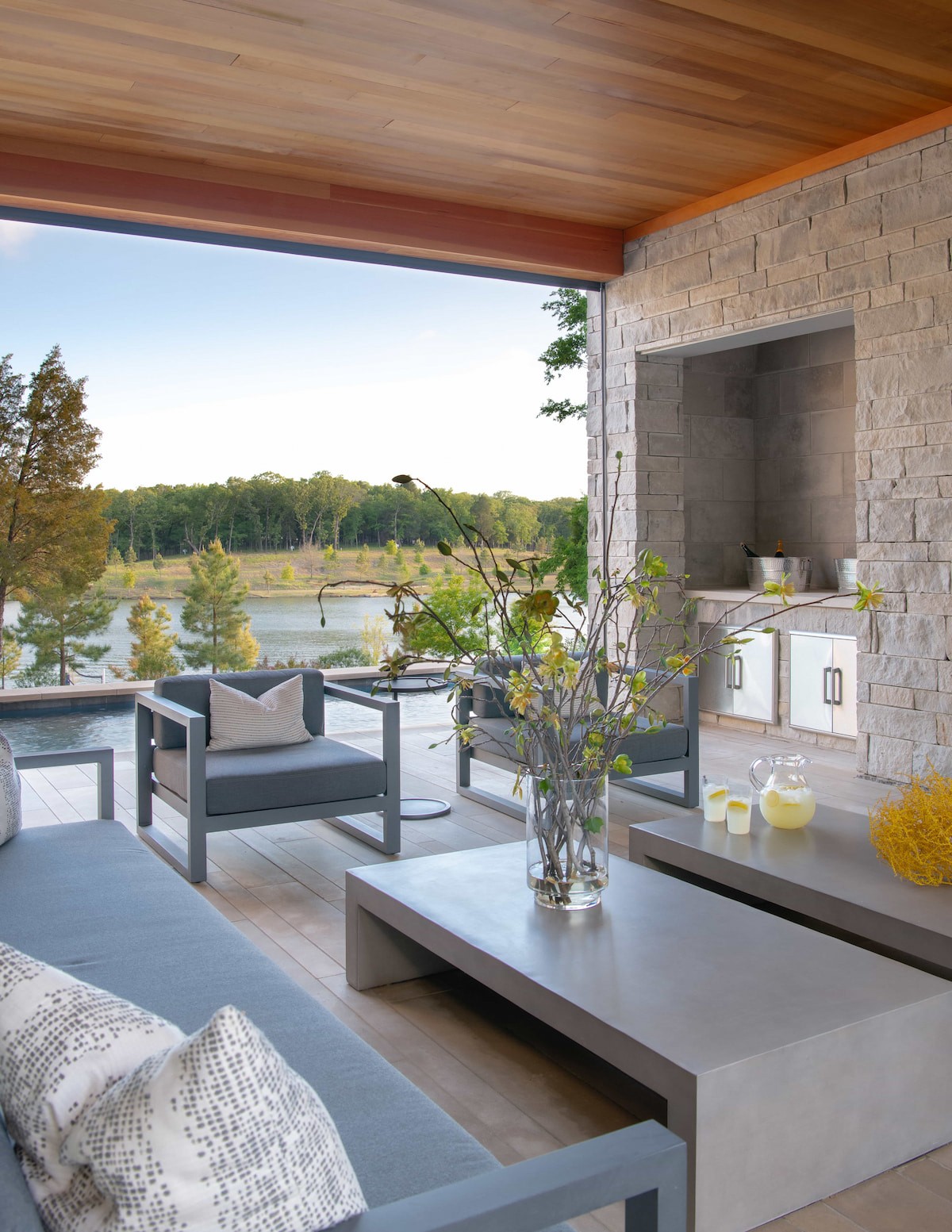
An outdoor fireplace makes more sense when the space needs a wall, a focal point and shelter, not just a flame. A fireplace anchors a covered patio or pergola the way an interior fireplace anchors a living room, and it can be placed to block a prevailing breeze or screen a view you would rather not see.
Fireplaces are taller and heavier than fire pits, and they become part of the architecture. That is their strength on a property where the house deserves an outdoor room built to the same standard. Most often we design them into a covered space alongside an outdoor kitchen, as part of a larger outdoor living and recreation plan, so the fireplace, the television wall and the seating are resolved together.
The trade-off is flexibility. A fireplace faces one direction, so it works best when the seating arrangement is settled and the view from the fire toward the yard is one you want to look at all evening.
Where Fire Bowls Belong
Fire bowls are at their best beside water. Set on a raised pool wall, flanking a reflecting pool or paired along a spa, they add flame and light at eye level, and the reflection doubles them. They are decorative first, so they work as punctuation in a design rather than as the place where everyone gathers.
That makes fire bowls a natural partner to a pool. On a raised wall at the far end of the water, a pair of bowls gives the pool a focal point from the house at night, and some designs combine fire and a spill of water in the same vessel. If you are planning a pool, fire bowls should be part of the pool and spa design from the beginning, because the gas line, the wall and the coping all have to be detailed for them before the shell is built.
Fire and water read as one composition when they are designed together, which is why our custom water features guide covers the water side of the same conversation.
Gas or Wood in North Texas?
Gas suits most luxury backyards in North Texas. It lights at a switch, produces no smoke or ash, and can be placed in more locations around seating and structures. Wood offers crackle and smell, but it brings smoke, embers and more rules about placement.
In Dallas, recreational fires are allowed in approved fire pits and containers, according to a summary of Dallas fire rules last updated in April 2026. That summary sets the fire at 15 feet from structures, requires it to be attended constantly with an extinguisher nearby, and notes that burn bans can prohibit all outdoor fires. Highland Park and University Park are separate municipalities and set their own rules, so the property's location matters.
Those conditions are a large part of why the fire features we design are typically gas. A gas fire can be placed where it serves the design, under a covered patio, on a pool wall or at the edge of a terrace, rather than wherever a fifteen-foot clearance happens to fit.
What to Settle Before Designing a Fire Feature
Before a fire feature is designed, settle where people will sit, which way the wind usually comes from, where the gas line will run, and how the fire will look from inside the house. Those four decisions determine whether a fire feature becomes the best seat in the yard or an object people walk past.
Wind matters more than most owners expect. An open flame in the wrong spot spends the evening leaning toward one side of the seating, and smoke from a wood fire follows the breeze toward whoever is downwind. Gas routing matters because a line to a fire bowl on a pool wall or a fireplace across the yard has to be planned before hardscape goes in, not cut into it afterward.
When fire is part of the early conversation, it shows. On our design intake form, fire pits, fireplaces and pool fire features are listed as separate choices alongside pools, covered structures and outdoor kitchens, because each one changes the plan in a different way.
Frequently Asked Questions About Outdoor Fire Features
Can a fire feature go under a covered patio?
A fire feature can go under a covered patio when it is designed for it. An outdoor fireplace with a proper chimney is the most common choice, because it carries smoke and heat up and away from the ceiling. Open fire pits under a roof need careful clearances and are usually gas rather than wood, and the structure, the ventilation and the local code all have to agree before one is built.
Can you add a fire feature to an existing pool?
A fire feature can be added to an existing pool, but the work is easier when the pool already has a raised wall or a wide coping to set it on. The main task is bringing a gas line to the location without disturbing finished hardscape. In many cases, fire bowls on new pedestals or a fire table at the pool's edge give the same effect with less disruption.
Are fire features worth it in a Texas climate?
A fire feature extends the months a backyard gets used in North Texas. Fall and winter evenings are often mild enough to sit outside with a fire, and spring evenings can turn cool after sunset. A well-placed fire turns those evenings into usable time outdoors, and at night the flame becomes one of the most visible parts of the landscape from inside the house.
Fire Is a Design Decision, Not an Accessory
The best fire features look like they were always meant to be there, because they were. They are placed for the people who will sit around them, sized to the space and detailed with the stone, water and planting around them. Browse our landscape projects, then talk with us about the fire and water features that belong on your property.
Request a design consultation and we will start with where you want to spend your evenings this winter.
By Bryce Arrington, Studio Manager, Blount Designs
Published October 2026
Related