Uncategory
Custom Outdoor Water Features in Dallas: Design, Integration, and What to Expect
-
Blount Designs Team
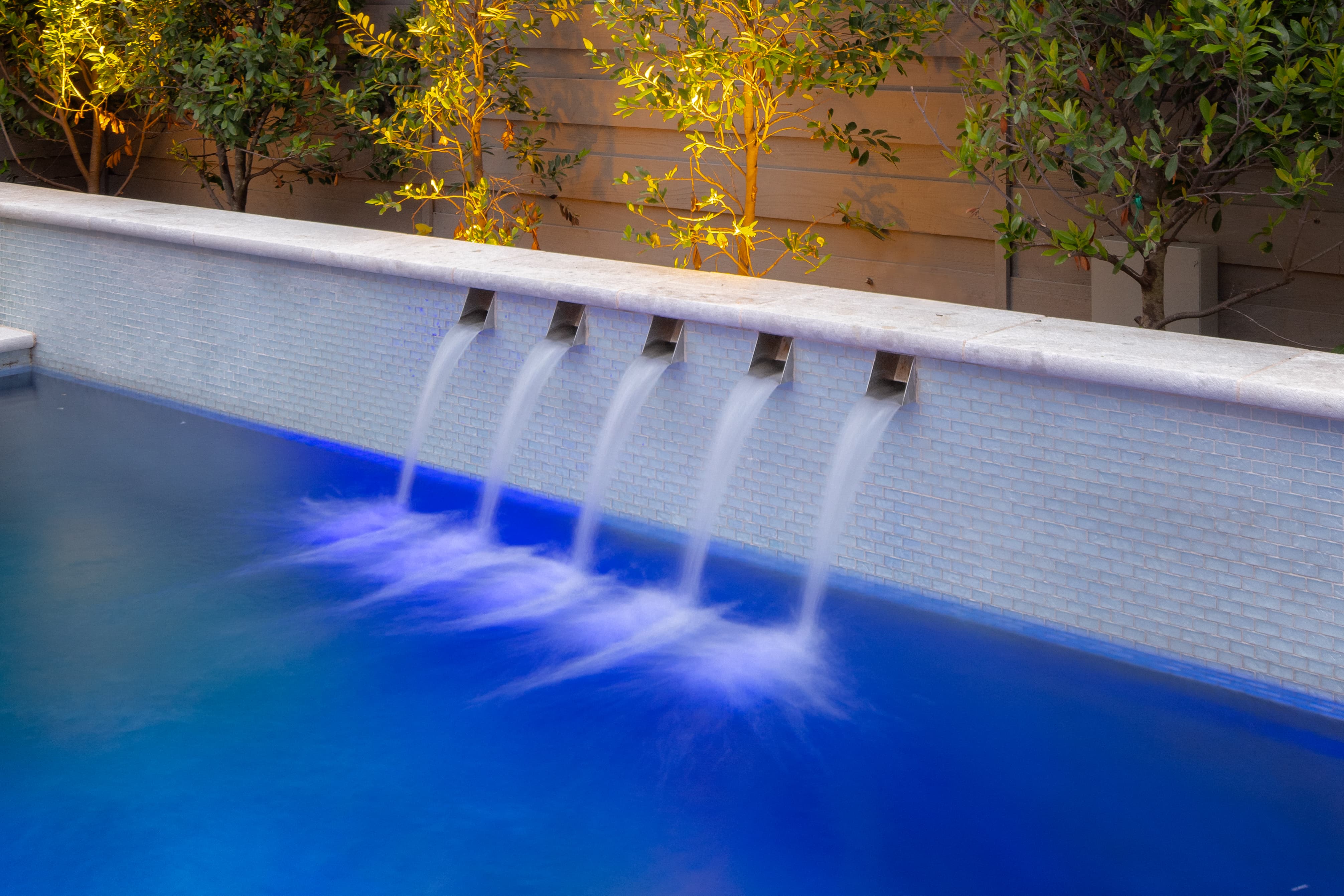
A custom outdoor water feature changes how a property feels rather than just how it looks. The sound of moving water carries further than its source — it softens mechanical noise, signals arrival, and creates a sensory boundary between the street and the garden. Done well, a custom water feature reads as something the landscape was designed around. Done without that design grounding, it reads as something that arrived in a box. The difference is not the product. It is how and where the feature was integrated into the water and fire features program and the landscape design as a whole.
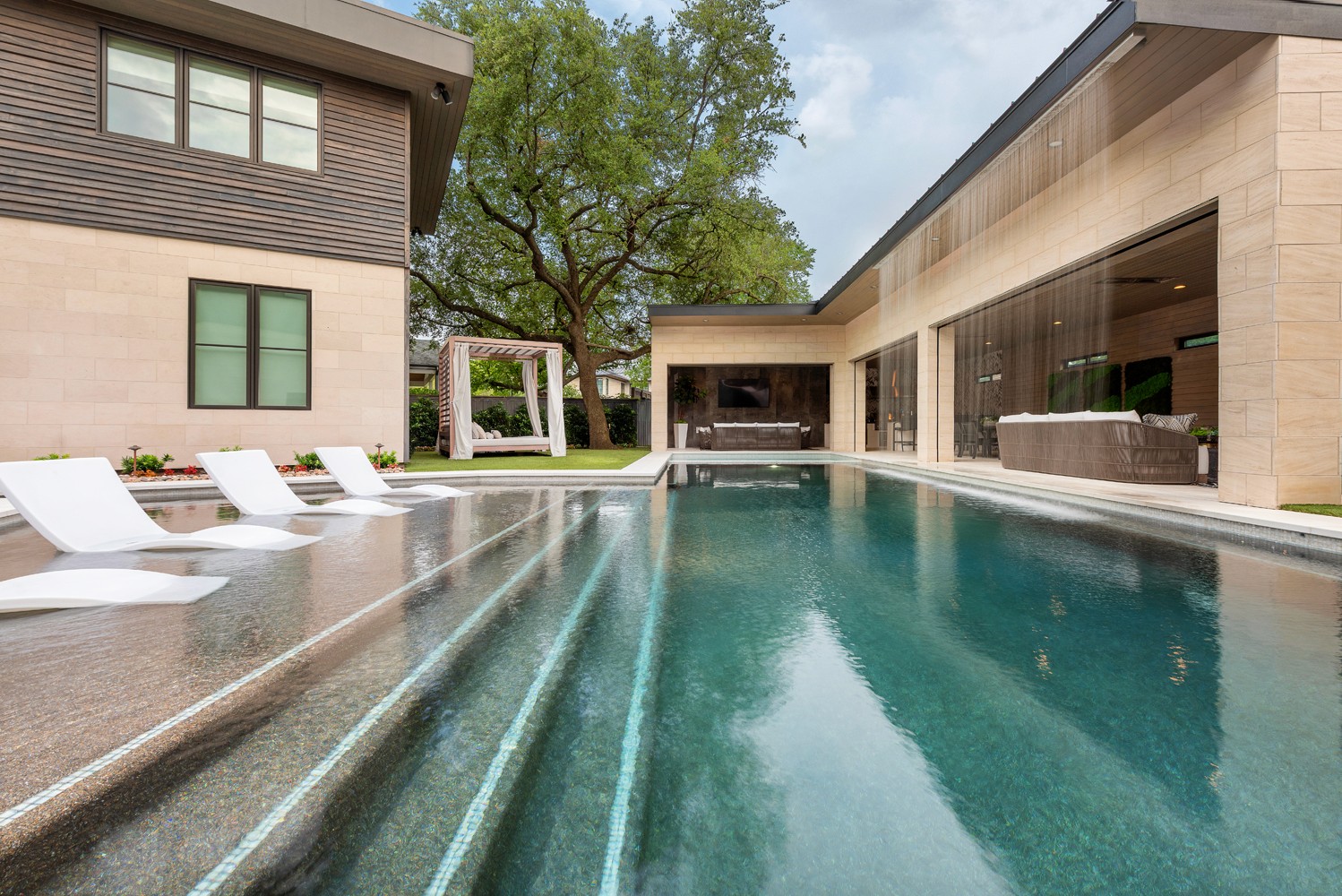
Dallas luxury properties have become a strong market for custom water features — rills in motor court walls, scupper spouts on garden entry walls, fire-and-water combinations on covered terrace edges, negative-edge pool walls that read as a single moving plane of water from the main living level. Each serves a different design intent. What they share is that they were specified, not selected. Schedule a design consultation if you have a property where a water element has been in the back of your mind but you have not found the right context for it.
What Is a Custom Outdoor Water Feature?
A custom outdoor water feature is a water element designed to the site — its scale, material, mechanical system, and placement specified in response to the architecture, the hardscape geometry, and the setting around it. That is the distinction from a builder-grade or catalog fountain: a custom feature is not selected from available options and installed. It is designed for one property and built to that specification.
The category is broader than most homeowners initially picture. It includes:
Scupper and spout walls — custom water spouts mounted on a masonry garden wall, motor court wall, or entry column, with water arcing into a basin or rill below. The spout hardware can be bronze, steel, copper, or cast stone depending on the architectural palette. It integrates into existing or new masonry without requiring a separate structure, and the sound-to-footprint ratio is excellent. The Preston Hollow Zen Retreat demonstrates how a wall-mounted water element can anchor an entire garden axis without competing with the surrounding planting.
Rills and channels — narrow linear water channels set into hardscape, running from a header element to a catch basin at grade. Rills work well on sloped lots and on properties where a linear water element reinforces the geometry of the terrace or entry sequence.
Cascade and waterfall features — water moving over stone or along a natural-looking rock face into a basin below. These tend to anchor naturalistic garden settings, pool surrounds, or transitional-style properties where the architecture supports organic material language.
Fire and water combinations — fire bowl or burner over a water basin, fire wall above a rill, or a trough carrying both flame and water on a covered terrace. These have become particularly common on DFW outdoor kitchens where the feature needs to anchor the space through multiple seasons.
Negative-edge and pool-wall features — water spilling over a pool edge, vanishing into a catch basin and recirculating. These blur the boundary between pool and landscape and require close coordination between the pool contractor and the landscape designer.
How Does a Custom Water Feature Integrate with the Landscape Design?
A water feature is a coordination point between hardscape, planting, mechanical, and sometimes pool — not a standalone product. That coordination is where most retrofit installations go wrong: the feature itself is fine, but its relationship to everything around it was never designed. The basin is the wrong size for the spout. The planting crowds the feature within two seasons. The mechanical equipment ends up visible. The electrical routing scars the paving.
When a water feature is part of the landscape plan from the start, those relationships are resolved before anything is built. The hardscape design carries the feature geometry, basin dimensions, and adjacent paving material. The planting plan frames the feature without encroaching on it. The mechanical spec — pump location, recirculating line, electrical supply, auto-fill — is in the construction documents so every trade knows the routing before the ground opens. For features adjacent to a pool, the coordination runs to the pool contractor as well: basin depth, edge treatment, and waterline tile typically need to match. Our outdoor living and recreation scope coordinates all of these trades under one design document rather than leaving each contractor to resolve their interface independently.
What Types of Custom Water Features Work Best for Dallas Luxury Properties?
The right feature type for a given property depends on the architecture, the lot, and the primary viewing context. There is no universally correct answer, but there are patterns that recur in the Dallas luxury market.
On formal or transitional properties — the architectural vocabulary of Highland Park, Preston Hollow, and the Park Cities — symmetrical scupper or spout walls on motor court and entry walls are the strongest move. The material follows the stone or masonry of the house exactly, so the feature reads as part of the architecture rather than an accessory to it. The spout hardware is where the detail lives: arc size, finish, and basin proportion. Getting those proportions right is design work, not product selection.
On properties with significant grade — Westlake, Montrachet, properties along the Trinity corridor — a rill or cascade that works with the fall of the lot is often more resolved than a flat-plane basin. The water does something the site was already set up to do.
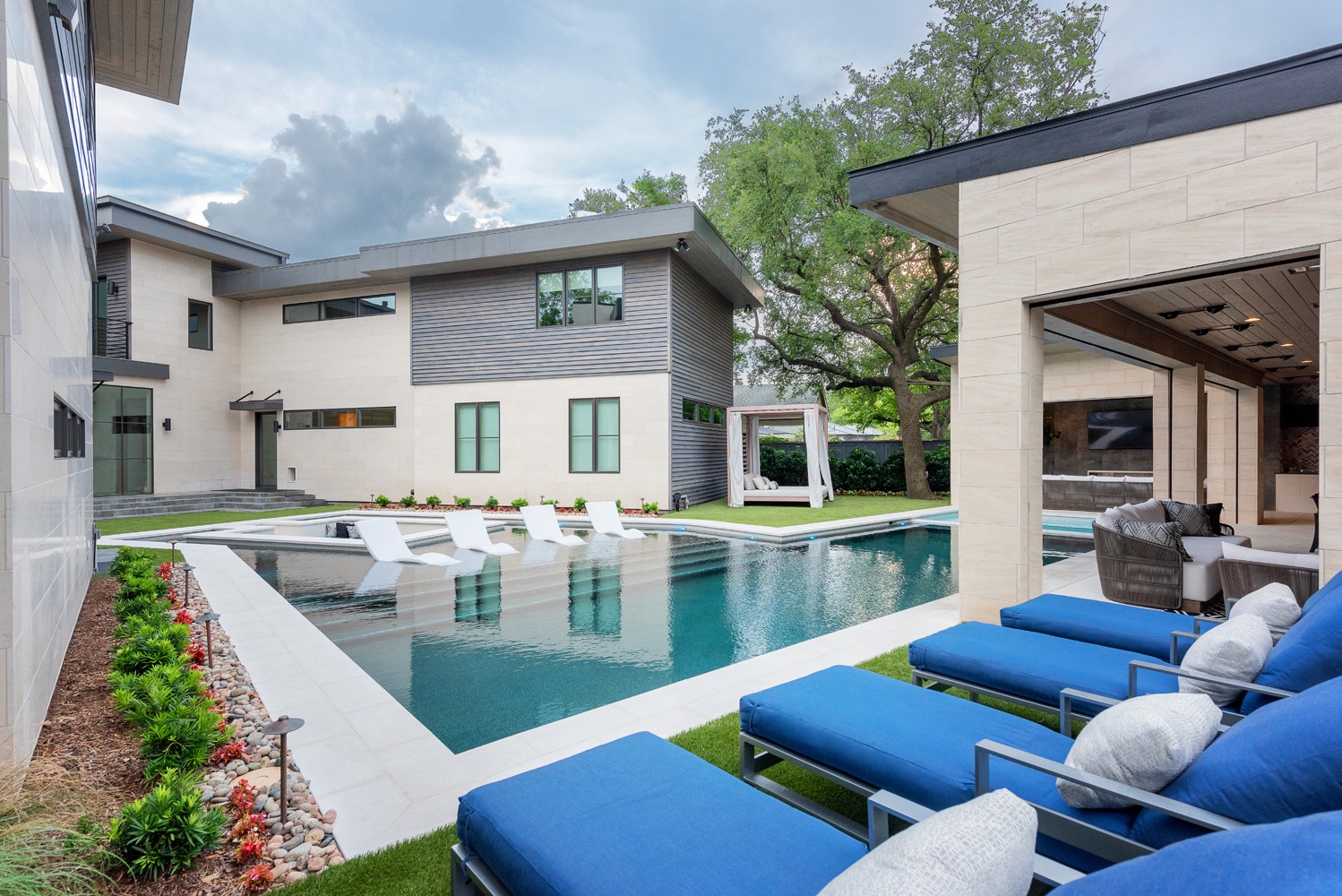
On outdoor kitchen and covered terrace installations, fire-and-water combinations anchor the space across the full DFW outdoor living season. A fire wall over a rill or fire bowl over a water trough requires coordination between the gas line and recirculating water system — both need to be in construction documents before any of it is built. The Modern Luxury Poolside Retreat shows how a poolside water element integrates into a single material language with the surrounding outdoor program.
For pool-adjacent work — negative-edge transitions, water walls, or spa-overflow features — the design runs through the pool contractor's scope. Our pools and spas coordination keeps that interface documented so the pool contractor's set and the landscape design set agree on materials, dimensions, and elevations.
What Does the Design Process Look Like for a Custom Water Feature in Dallas?
The design process for a custom water feature follows the same stages as any other landscape design scope: site evaluation, schematic design, design development, construction documents, and construction-phase coordination. What changes with a water feature is that the mechanical system adds a documentation layer that a planting bed or retaining wall does not carry.
At the site evaluation stage, the question is where a water element makes sense rather than where it would fit. A feature placed at the end of a sightline, in the space between two architectural elements, or at a grade transition reads as resolved. One placed in available space reads as an afterthought. The evaluation looks at primary viewing distances, existing hardscape geometry, mechanical and electrical routing paths, and the property's material language.
At schematic design, the feature type, scale, and approximate material are fixed. At design development, the material schedule, spout or coping detail, basin dimensions, and mechanical concept are resolved. At construction documents, the full mechanical spec — pump sizing, recirculating line routing, auto-fill, drainage, electrical supply — is drawn out alongside the hardscape and planting details. For context on what a complete landscape design document set looks like across these stages, our post on what a landscape site plan includes walks through the full deliverable structure.
Construction-phase coordination involves at minimum a mechanical trade and an electrician — often also a mason, pool contractor, or stone installer depending on the feature type. Each trade receives the relevant documentation from the design set so coordination runs through drawings, not on-site improvisation.
How Does Dallas's Clay Soil Affect Water Feature Engineering?
Dallas and Fort Worth sit on highly expansive clay soil that swells when wet and contracts when dry — movements significant enough to affect paving, foundations, and the basin and mechanical systems of a recirculating water feature.
A water feature that allows water to escape the recirculating system — through overspray, a slow basin leak, or a gap at the edge — introduces a localized moisture condition into that expansive clay. Over time that registers as movement in the adjacent paving or wall. The mechanical spec for a Dallas water feature needs to account for this: basin liner, basin-to-hardscape connection, overflow path, and drainage routing are all engineered to keep water inside the recirculating system. A well-engineered recirculating system performs for decades without contributing to paving movement. An under-spec'd one becomes a maintenance problem within the first dry-wet cycle. The distinction is in the design document, not the installation.
Frequently Asked Questions About Custom Outdoor Water Features in Dallas
What makes a custom outdoor water feature different from a builder-grade fountain?
A custom water feature is designed to the site — its scale, material palette, and mechanical system are specified in response to the architecture, the hardscape geometry, and the planting program around it. A builder-grade fountain is a product selected from a catalog and installed without those relationships in mind. The difference shows in proportion: a feature that is the right scale for its setting reads as part of the landscape. One that is too small, too large, or materially disconnected reads as an afterthought regardless of how well it is made.
Can a custom water feature be added to an existing Dallas landscape without a full redesign?
Yes, in most cases. The most common retrofit is a scupper or spout wall on an existing garden or motor court wall — the masonry is already there, the feature is designed into the face of it, and a recirculating basin and pump are installed at the base. A standalone rill or basin-and-boulder feature can also be added to an existing planting bed or garden terrace without disturbing the broader landscape. What changes with a retrofit is the mechanical routing: power and recirculating water lines need a path to their destination, and that path has to be planned before anything is opened up.
How do I know what size and type of water feature is right for my property?
Scale is the first filter: the feature needs to be large enough to read from the primary viewing distance — typically from inside the house looking out, or from a hardscape seating area — without overpowering the architecture. Type follows from context: a formal motor court entry reads best with a symmetrical spout wall or rill; a naturalistic garden setting reads best with a cascade or boulder-and-basin feature; a covered outdoor kitchen reads best with a fire-and-water combination that carries heat and movement together. The design conversation starts with the site, not a product selection.
How does the Dallas climate affect water feature design and maintenance?
Dallas summers produce significant evaporation from open water surfaces — a recirculating system needs an auto-fill line to maintain consistent water levels without weekly manual top-offs. The winter freeze risk is real but manageable: equipment must be specified for freeze tolerance, and the pump should be on a smart controller that can be shut down quickly when temperatures drop. Algae growth accelerates in the summer heat, which is managed through the mechanical spec — circulation rate, UV treatment if warranted, and appropriate basin surface materials. None of these are obstacles; they are design variables that get resolved in the spec phase before the feature is built.
Schedule a design consultation to talk through a custom water feature for your property — whether that is a scupper wall on an existing garden, a fire-and-water element on a covered terrace, or a pool-adjacent feature that needs to be coordinated with a pool contractor's scope. We will walk through the site, the architecture, and the mechanical routing before any design work begins.
Related