
Landscape Rebuild
Why Geometry Transforms Small Luxury Properties in Park Cities and Dallas
-
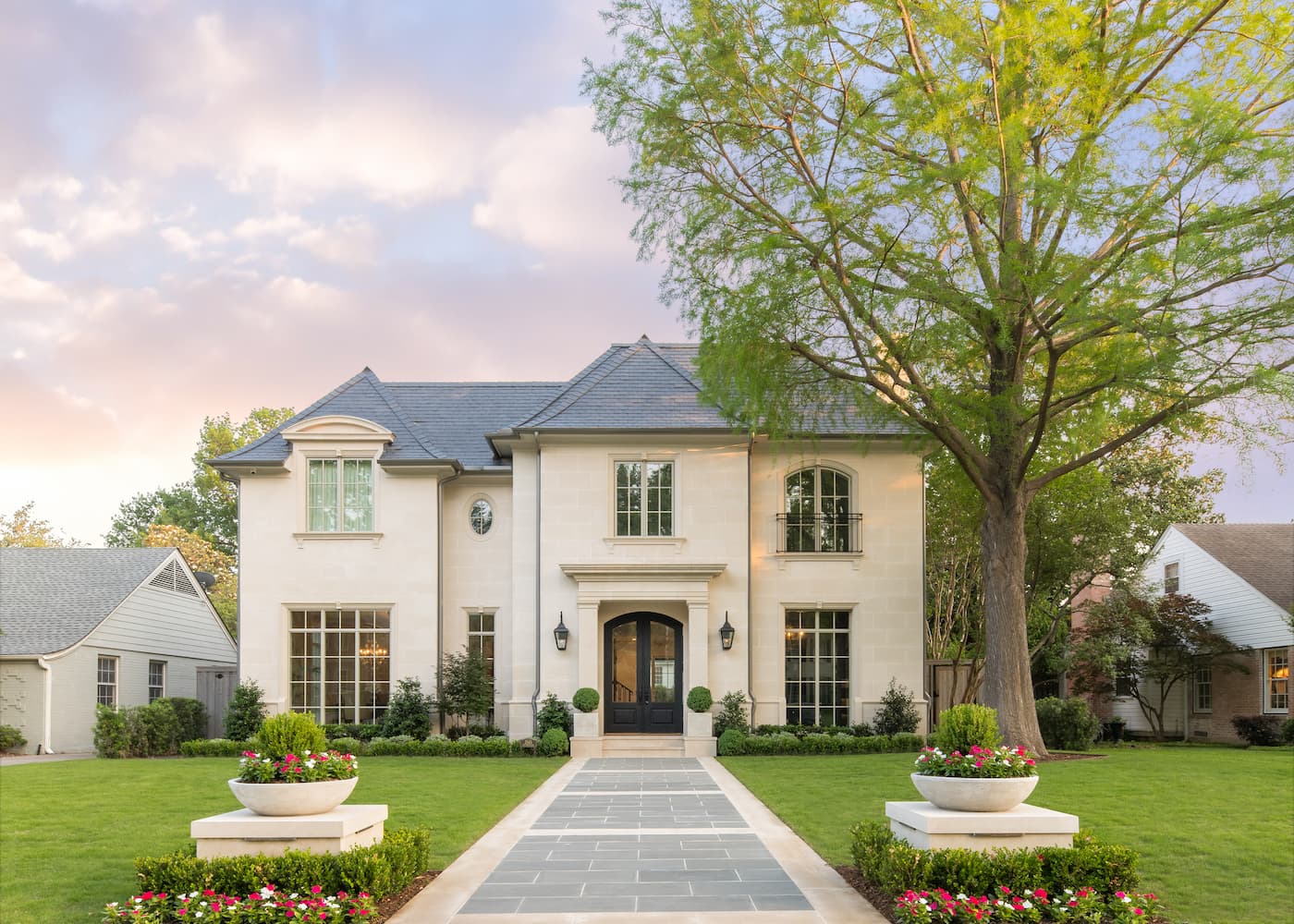
When you're working with a smaller luxury property in Highland Park, University Park, or North Dallas, every square foot matters. Unlike sprawling suburban estates with acres to spare, urban luxury homes demand a different design approach—one where precision and intentionality create the illusion of space while delivering maximum impact.
The secret? Geometry.
After designing landscapes for dozens of high-end Dallas properties, we've learned that geometric design principles don't just make small spaces look better—they fundamentally transform how you experience your property. Let us show you why this matters and how professional design makes all the difference.
The Park Cities Challenge: Limited Space, Unlimited Expectations
Here's the reality of luxury properties in Highland Park, University Park, and established Dallas neighborhoods: you might have a $2 million home on a 7,500-square-foot lot. Your neighbors expect immaculate curb appeal. Your property value depends on maintaining neighborhood standards. And you want an outdoor space that feels expansive, not cramped.
This is where most DIY landscape efforts fall short. Without a clear geometric framework, small properties end up feeling even smaller—cluttered with random plantings, disconnected features, and no cohesive flow.
A professional landscape designer approaches your property differently. We see the potential for clean lines, intentional sightlines, and spatial organization that makes every inch work harder.
We offer free consultations to assess your property and discuss how geometric design could work for your specific lot. Schedule a time to walk your property with us.
Why Geometry Creates the Illusion of Space
Think about the difference between a cluttered room and a minimalist one of the exact same size. The minimalist room feels larger because your eye can travel uninterrupted across clean surfaces and defined edges.
The same principle applies to your landscape.
Geometric Lines Direct the Eye
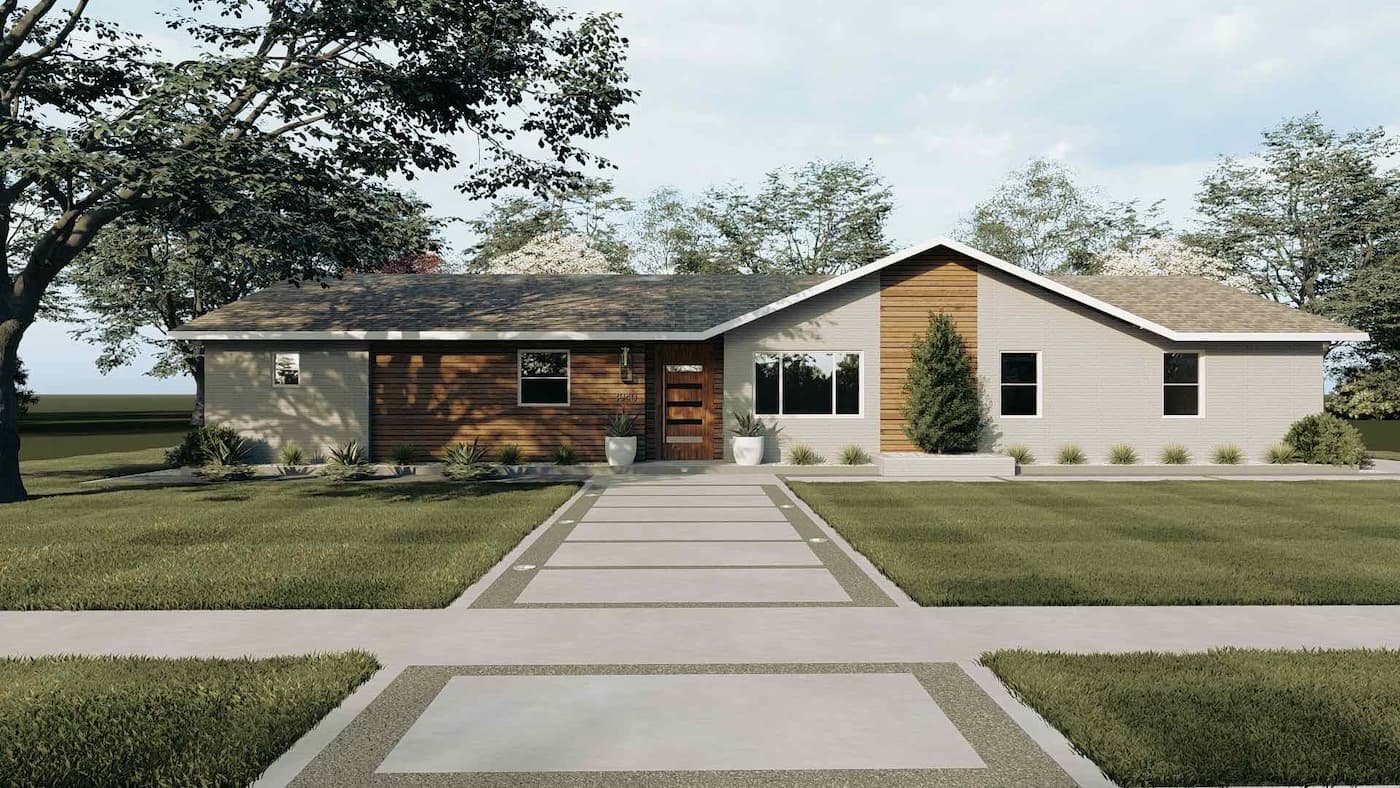
When we design walkways and garden paths with strong geometric lines, we're doing more than creating a route from point A to point B. We're controlling how you perceive the space.
Linear pathways draw the eye forward, making your property feel longer than it actually is. Perpendicular lines create defined zones—a dining area here, a garden bed there—that organize space instead of letting it blur together into visual chaos.
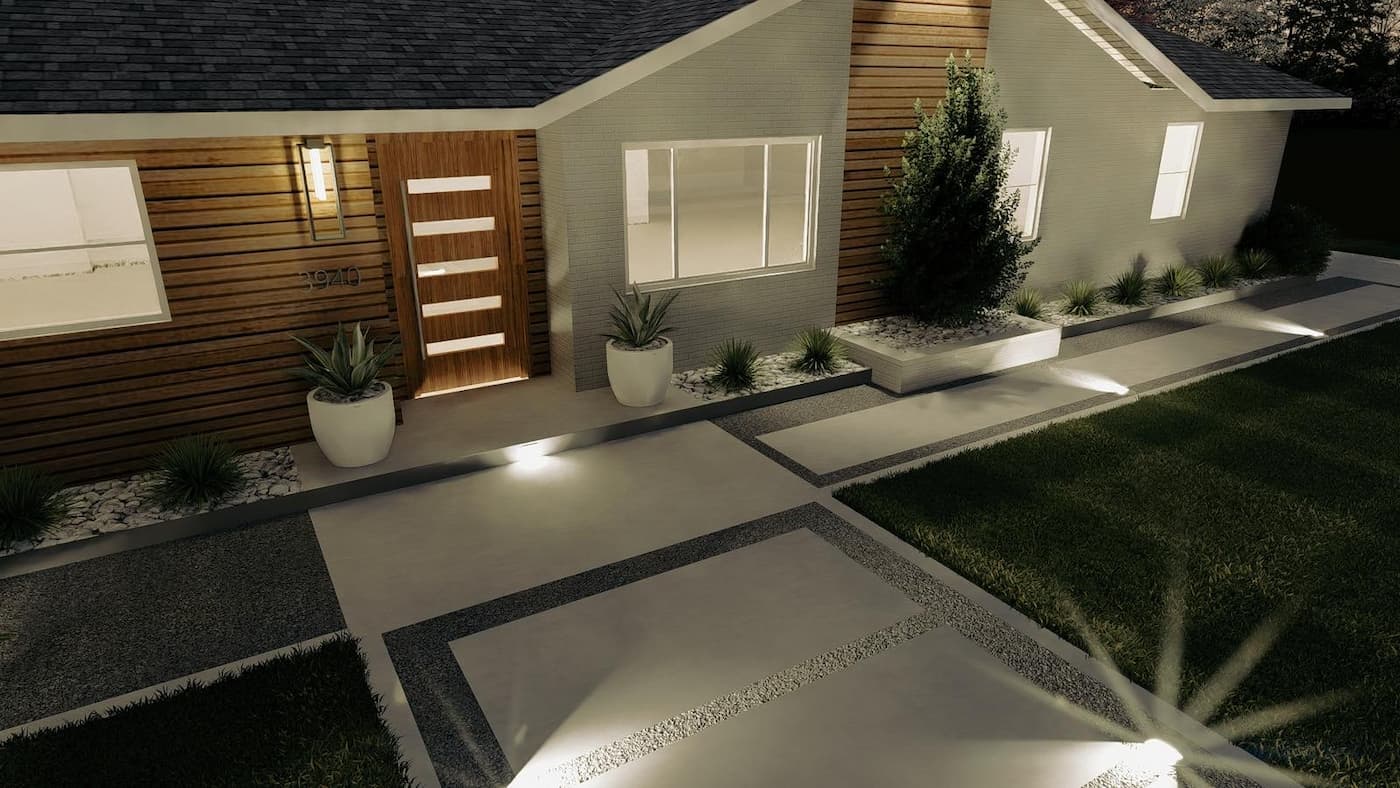
On compact lots, this spatial organization is everything. Without it, you're left with an undefined outdoor area that serves no clear purpose and feels awkward to use.
Symmetry Signals Intentional Design
There's a reason Park Cities homes lean heavily toward symmetry in their architecture—it communicates order, balance, and investment. Your landscape should echo this.
When we create symmetrical planting beds flanking an entry walk, or mirror retaining walls on either side of a patio, we're telling visitors that every element was carefully considered. This level of intention is what separates luxury properties from average ones.
But here's what most homeowners don't realize: achieving true symmetry is harder than it looks. Plants grow at different rates. Sight lines shift depending on where you're standing. A professional designer knows how to account for these variables, creating symmetry that works in real life, not just on paper.
Repetition Creates Rhythm
One of the most powerful tools in geometric design is repetition. When you repeat a specific pattern, material, or shape throughout your landscape, you create visual rhythm that unifies the entire property.
For example, if your front yard design includes rectangular planting beds with boxwood hedges, repeating this geometric shape and plant choice in your backyard courtyard creates cohesion. Your property starts to feel like a planned estate rather than a collection of unrelated features.
On small lots, this cohesion is critical. You don't have the luxury of spatial separation to distinguish different areas. Geometric repetition provides that structure without requiring square footage.
How Geometry Solves Common Small-Lot Problems
Let us walk you through specific challenges we see constantly in Park Cities and North Dallas, and how geometric design solves them.
Problem: Awkward Property Proportions
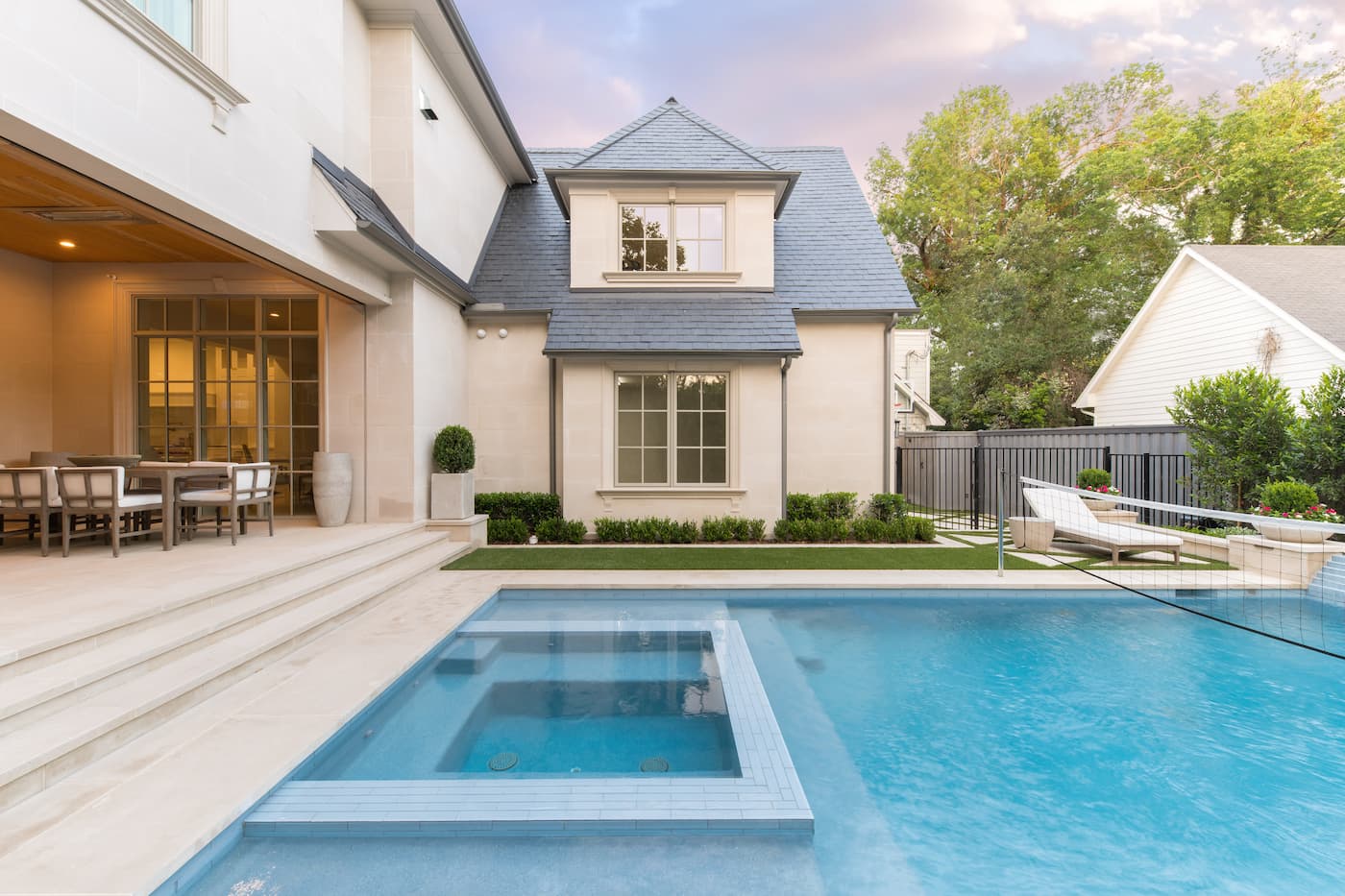
Many Dallas lots are narrow and deep, or oddly shaped due to corner positions or irregular platting. These proportions feel uncomfortable—too long, too thin, or just... off.
Geometric solution: We use perpendicular lines to "interrupt" difficult proportions. A series of custom patios and terraces stepping down a long, narrow yard creates distinct outdoor rooms. Each geometric platform breaks up the tunnel effect and gives you usable spaces instead of one awkward corridor.
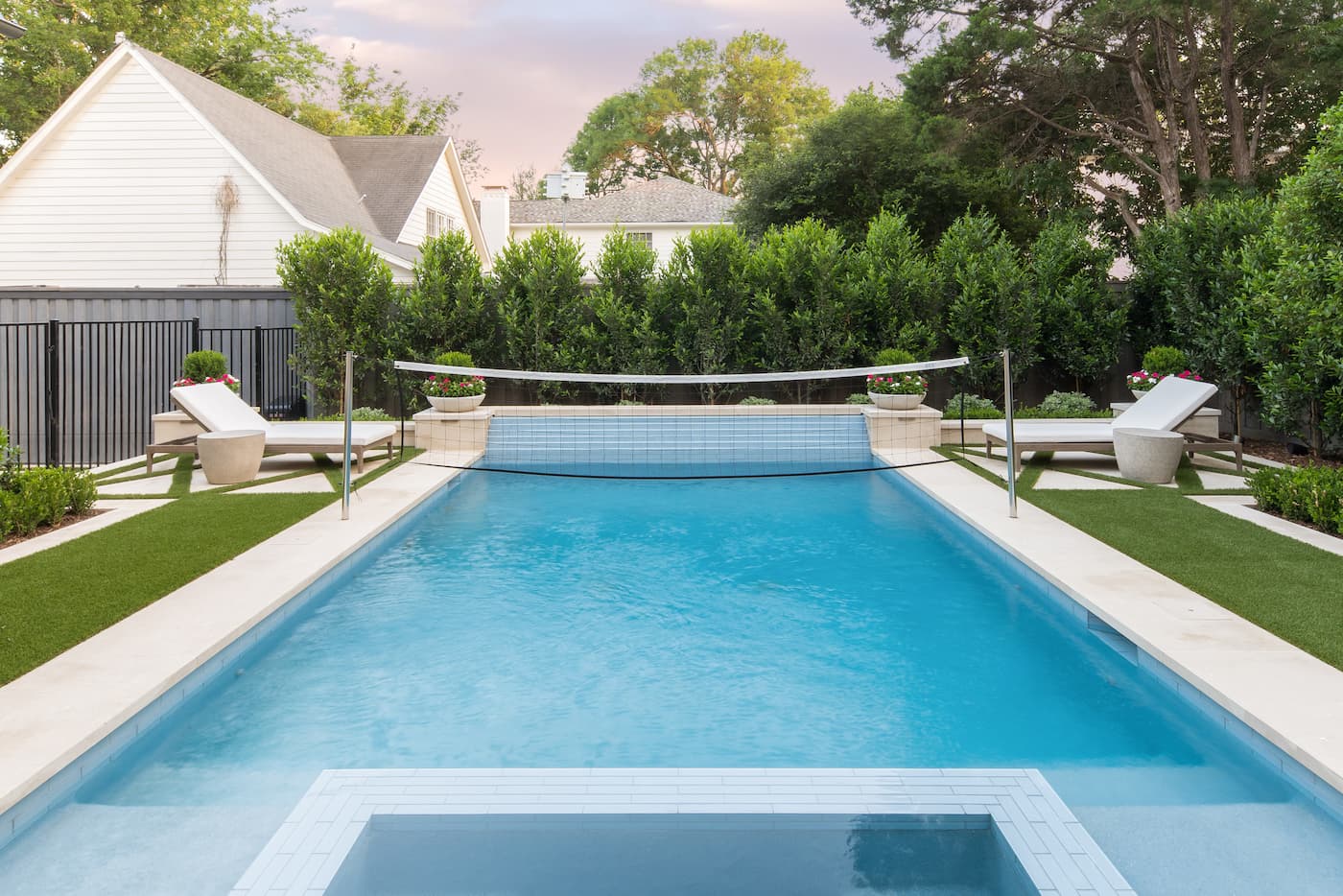
Cross-axis pathways work the same way. By running a secondary walkway perpendicular to your main sightline, we create visual width that counteracts narrow proportions.
Problem: No Privacy Without Sacrificing Light
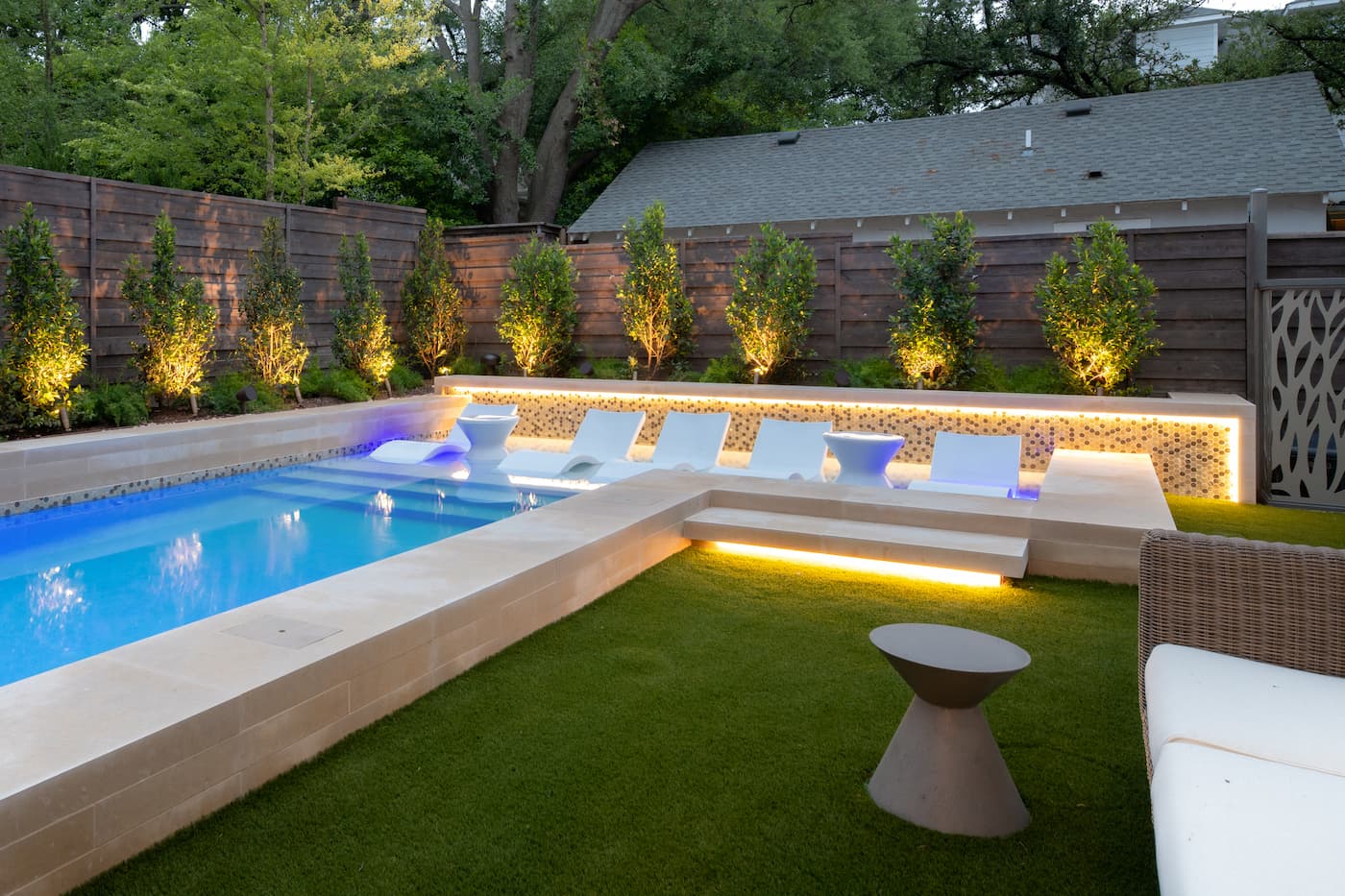
Park Cities lots sit close together. You want privacy from neighbors, but tall fences create a boxed-in feeling and block natural light.
Geometric solution: Layered geometric screening. We design decorative walls at varying heights, combined with strategic plantings in geometric beds, to create privacy without solid barriers.
Picture this: a 3-foot seat wall with a 2-foot planted bed behind it, backed by a 6-foot section of vertical slat fencing in just the area where you need screening. The varied heights and geometric layering provide privacy while keeping sightlines open where it matters.
This is the kind of spatial problem-solving that requires professional eyes. We're not just placing elements—we're choreographing how you experience the space from multiple vantage points.
Problem: Disconnected Outdoor Features
You have a small patio, some garden beds, and a walkway, but they feel like random elements dropped onto your property with no relationship to each other.
Geometric solution: A unifying grid system. Professional designers start every project by establishing a geometric grid that ties everything together.
Your patio dimensions might be based on a 3-foot module. Your planting beds align to the same 3-foot grid. Your walkway width is a multiple of that module. Suddenly, every element relates to every other element mathematically—even if you can't consciously identify why it looks "right."
This is the invisible work of professional landscape design. The geometry creates subconscious harmony that makes your property feel cohesive and well-planned.
This is what we evaluate during our free consultations. We'll identify the geometric framework your property needs and explain how to unify your outdoor spaces.
Problem: Limited Curb Appeal
You have 25 feet of frontage visible from the street. How do you create impact in such a small canvas?
Geometric solution: Maximum contrast through geometric precision. When space is limited, perfection matters more.
A geometric front entry sequence might include: precisely edged planting beds with repeating ornamental grasses, a linear walkway with soldier-course borders, and symmetrically placed decorative planters flanking your door. Every edge is sharp. Every line is intentional. Every element reinforces the others.
The result? Your 25-foot frontage delivers as much visual impact as properties with twice the space—because every inch is optimized.
The Professional Advantage: What You Can't See
Here's what separates professionally designed geometric landscapes from DIY attempts—and it's not what you'd expect.
We Design in Three Dimensions
Most homeowners think in two dimensions when planning their landscape. You sketch where the patio will go, where the beds will be, where the path will run.
Professional designers think in three dimensions constantly. We're considering:
How will the retaining wall height affect your sightline from the kitchen window?
When you're seated on the patio, what will you see? What should be hidden?
As you walk toward the entry, how does the spatial experience unfold?
Where will shadows fall at different times of day?
This three-dimensional thinking is where geometric design becomes transformative. We're not just drawing rectangles on a plan—we're choreographing your movement through space and controlling what you see from every angle.
We provide free consultations because seeing your property in person is essential. We'll walk your lot, assess sightlines from multiple angles, and show you what geometric design could achieve on your specific property.
We Account for Growth and Change
Here's a mistake we see constantly: someone plants a perfect geometric hedge, but doesn't account for mature width. Two years later, the plants have grown together into a blob, destroying the intended geometry.
Professional designers specify plant sizes, spacing, and growth rates to maintain geometric integrity over time. We know which boxwoods stay tight and which spread. We understand that maiden grass needs 4 feet of width at maturity, so we position it accordingly in the geometric framework.
We also design for seasonal change. Geometric hardscape—patios, walkways, and walls—provides year-round structure, while plantings add seasonal interest without compromising the underlying geometry.
We Balance Geometry with Softness
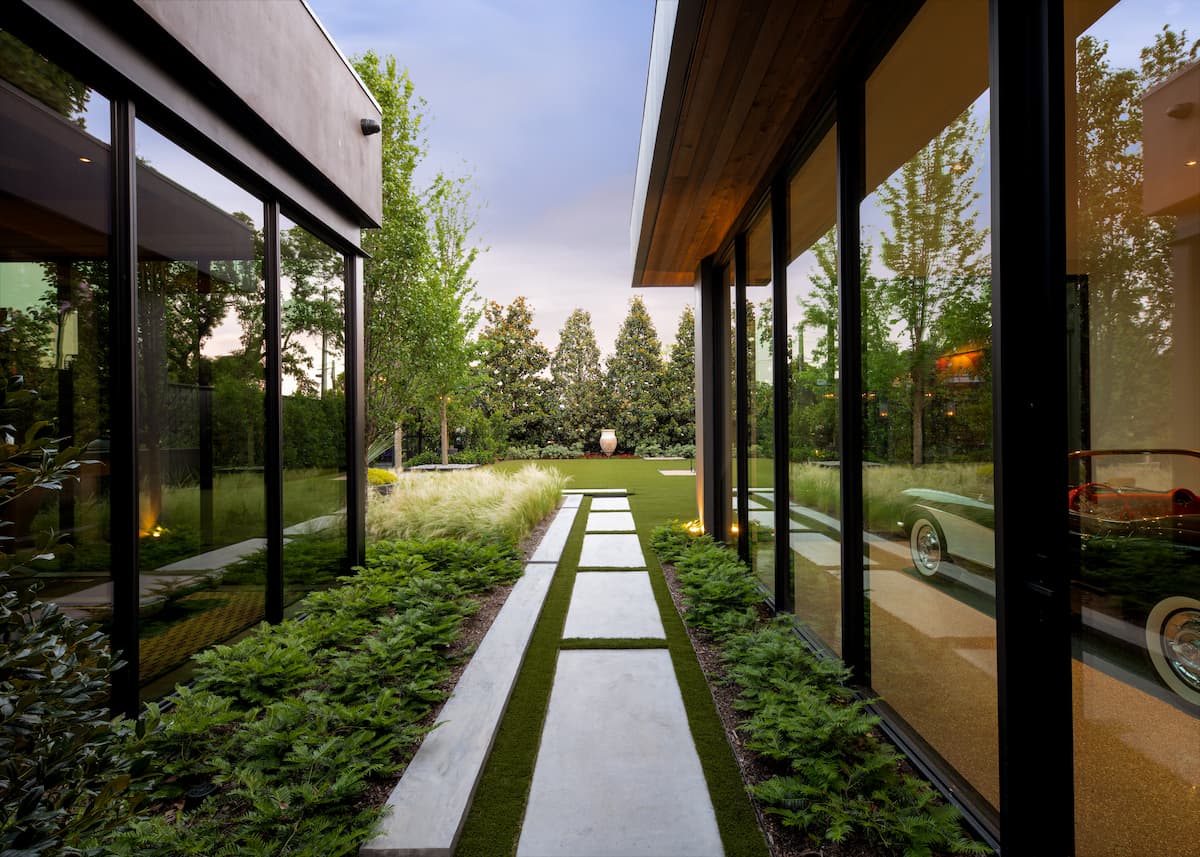
This is perhaps the most important skill: knowing when to soften geometric hardscape with organic plantings, and when to keep things crisp and architectural.
Pure geometry can feel cold. Pure organic design can feel chaotic. The art is in the balance.
For a Park Cities property, we might design a geometric limestone patio with perfectly rectangular lines, then soften the edges with flowing ornamental grasses that spill slightly over the border. The hardscape provides structure. The plantings provide life. Together, they create sophistication.
This balance requires experience. Too much softness, and you lose the spatial definition that makes geometry work. Too much rigidity, and the space feels unwelcoming. A professional designer knows exactly where that line is for your specific property and architectural style.
Real-World Application: A Park Cities Front Yard
Let us walk you through how geometric design transforms a typical Park Cities challenge.
The property: 1950s ranch-style home on a 50-foot-wide lot in University Park. The front yard is shallow—only about 30 feet from the street to the front door. Previous landscape was a mass of overgrown foundation shrubs with no definition.
The geometric solution:
We started with a strong central axis—a 4-foot-wide linear walkway running straight from the sidewalk to the front door, using large-format rectangular pavers. This immediately gave the property a sense of purpose and direction.
On either side of the walkway, we created perfectly symmetrical geometric planting beds—two rectangles on each side with 90-degree corners and crisp steel edges. The geometric beds got planted with repeating masses: dwarf Yaupon holly pruned into spheres, 'Blonde Ambition' blue grama grass, and seasonal color rotations.
The key was the negative space. By keeping the geometry clean and the plantings restrained, we made the 30-foot depth feel intentional rather than cramped. Every element had a clear geometric relationship to every other element.
The result? What was previously a forgettable front yard became a sophisticated entry sequence that photographs beautifully and signals to visitors—and potential buyers—that this is a well-maintained luxury property.
When to Call a Professional Designer
You might be wondering: can I achieve geometric design on my own?
Honestly? Some aspects, yes. You can certainly edge your beds with crisp lines and choose rectangular pavers instead of curved flagstone.
But here's when you absolutely need professional help:
1. When spatial relationships matter. If you're trying to make a small lot feel larger, or create multiple functional zones in limited space, you need someone who understands three-dimensional spatial design. This is where professional training and experience are irreplaceable.
2. When you're investing in hardscape. Custom patios, retaining walls, and walkways are expensive and permanent. Getting the geometry wrong means living with a costly mistake or paying to tear it out and start over. A professional gets it right the first time.
3. When property value is at stake. In Park Cities and North Dallas, your landscape isn't just personal enjoyment—it's a significant component of your property value. Poor landscape design can actually detract from your home's worth. Professional design protects and enhances your investment.
4. When you want cohesion across multiple features. If you're planning a complete outdoor environment—pool area, outdoor kitchen, gardens, and hardscape—you need an integrated design approach. This is where the geometric framework becomes essential for tying everything together.
The Park Cities Standard
Here's something to understand about luxury neighborhoods in Dallas: landscape design isn't optional. It's an expectation.
Your neighbors maintain impeccable properties. New buyers touring your neighborhood expect a certain standard. And that standard increasingly means professionally designed, geometrically organized landscapes that demonstrate care and investment.
Geometric design has become the visual language of luxury in these neighborhoods because it signals:
Professional involvement (not DIY)
Maintenance commitment (geometric edges require upkeep)
Spatial awareness (thoughtful use of limited space)
Architectural harmony (design that complements your home)
When your property displays these qualities, you're not just creating a beautiful landscape—you're maintaining the neighborhood character that supports everyone's property values.
Moving Forward
If you're looking at your property right now and seeing wasted space, awkward proportions, or disconnected elements, you're not alone. Most Park Cities and North Dallas homeowners are dealing with the same constraints: valuable property, limited space, and high expectations.
The question isn't whether geometric design would improve your property—it's how to implement it effectively.
Start by looking at your outdoor space with fresh eyes. Where could strong lines create definition? Where could symmetry bring balance? Where could geometric repetition unify disconnected areas?
Then ask yourself honestly: do you have the three-dimensional spatial design skills to execute this vision? Do you know which plants will maintain geometric integrity as they mature? Can you create a grid system that ties everything together?
If the answer is no—and for most homeowners, it is—that's exactly when working with a professional landscape design team makes sense.
We bring the spatial training, the technical knowledge, and the years of experience solving exactly these challenges on properties throughout Highland Park, University Park, Preston Hollow, and North Dallas.
Your property has more potential than you realize. Geometric design is how we unlock it. Schedule a free consultation. We'll walk your property, discuss your goals, and show you exactly how geometric design principles apply to your specific lot. No obligation. Just professional insight into what's possible.
Related


