
Design
Negative Edge & Infinity Pools: A Dallas Design Guide
-
Blount Designs

Few features change the character of a backyard the way a vanishing edge does. A negative edge pool — the construction detail behind what most people call an infinity pool — turns the water surface into a sheet that seems to drop into the view beyond it. Done well, it is one of the most striking moves available in luxury outdoor design. Done without the right engineering, it is also one of the least forgiving, which matters a great deal on North Texas soil. This guide covers how negative edge and infinity pools are designed and built for Dallas properties: what the terms actually mean, what local soil demands of the structure, and how to plan one so it works as part of the whole landscape rather than as a feature dropped into it.
What Is a Negative Edge Pool, and How Is It Different From an Infinity Pool?
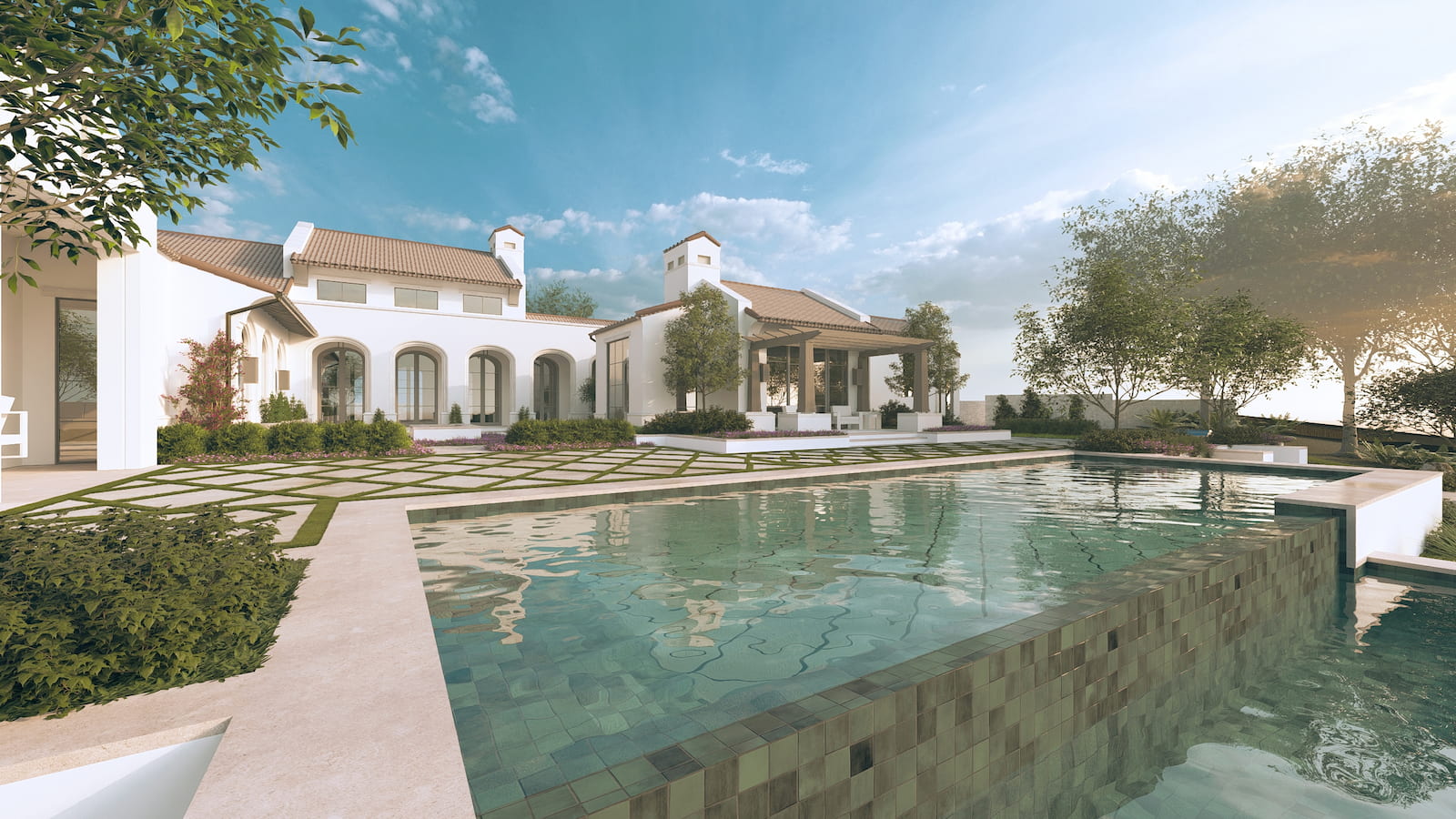
The two terms describe the same effect from different angles, and the pool industry uses them interchangeably. An infinity pool is the popular name for the look — water that appears to run off into the horizon with no visible boundary. A negative edge, also called a vanishing edge, is the construction detail that produces it: one wall of the pool is built slightly lower than the water line, so water spills continuously over that edge into a hidden catch basin below. A pump returns the captured water to the pool, and the cycle is constant. In other words, an infinity pool relies on a negative edge to create its signature vanishing-water effect.
It helps to distinguish a negative edge from two related details. A knife edge or slot-overflow pool brings water flush to a perimeter slot for a still, mirror-like surface, with no spill into a view. A perimeter overflow pool spills on all sides into a surrounding slot. A negative edge, by contrast, spills over one chosen side toward something — and that "something" is what makes the feature work.
Why Do Negative Edge and Infinity Pools Suit Luxury DFW Properties?
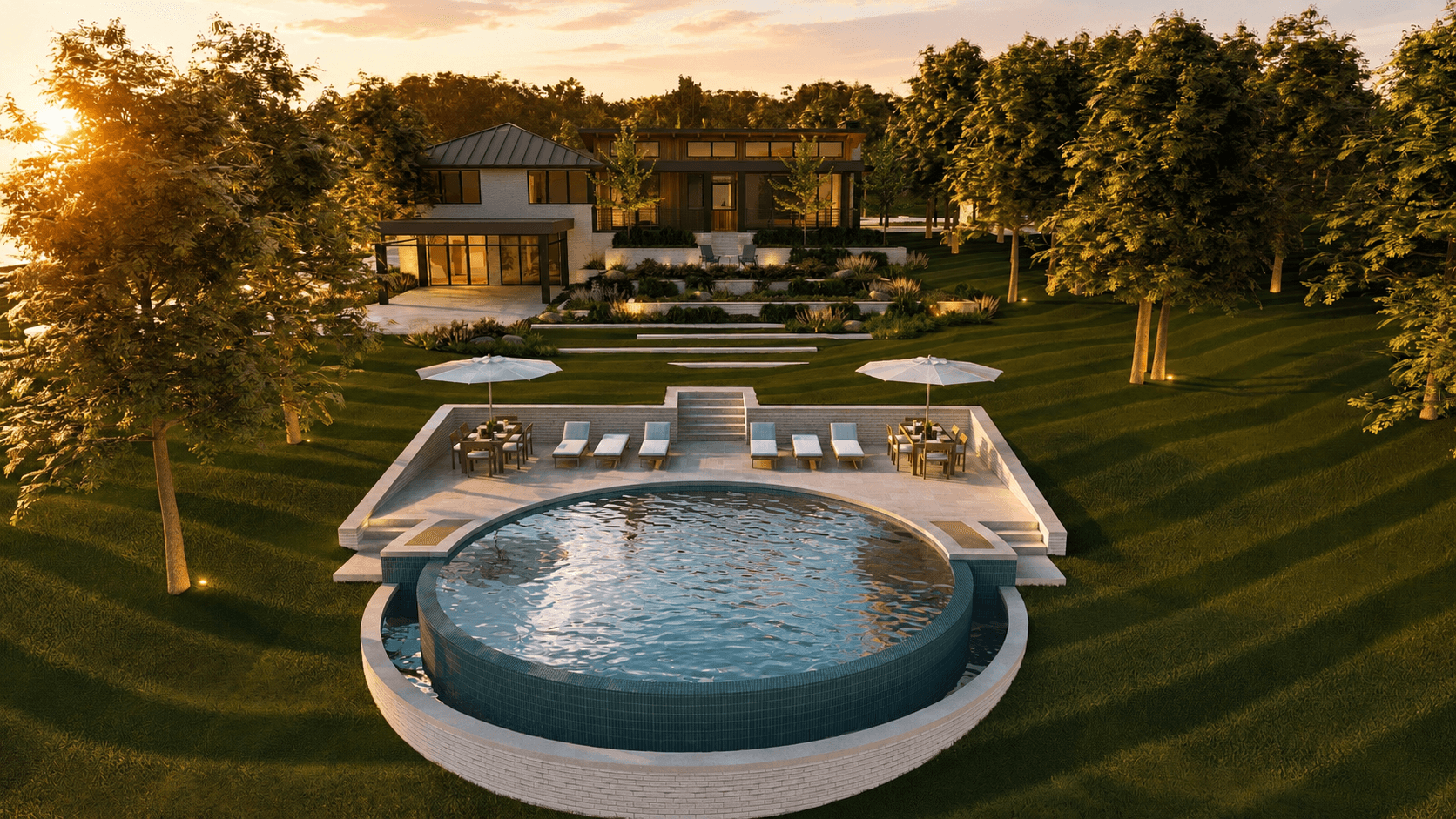
The vanishing edge earns its place where there is something to spill toward: a downward slope, a green belt, a tree line, a lake, or a composed landscape beyond the pool. Across DFW's luxury markets — the estate lots of the Park Cities, the new-build corridors in Frisco and Westlake, and acreage west of Fort Worth — those conditions show up often, whether as a natural grade change or as a view the design can frame. A negative edge is also, fundamentally, a sightline feature: it reads best when the pool is positioned so the edge is visible from the house and the main entertaining areas, which is the kind of decision that belongs in the early design phase rather than after the shell is poured.
It is no accident that this is a recurring request from Dallas homeowners. The vanishing edge often becomes the centerpiece of an outdoor living and recreation space, and it pairs naturally with the other water and fire elements that define a luxury backyard. Composing those together from the start is what separates a designed environment from an assembled one.
What Goes Into Designing a Negative Edge Pool in North Texas?
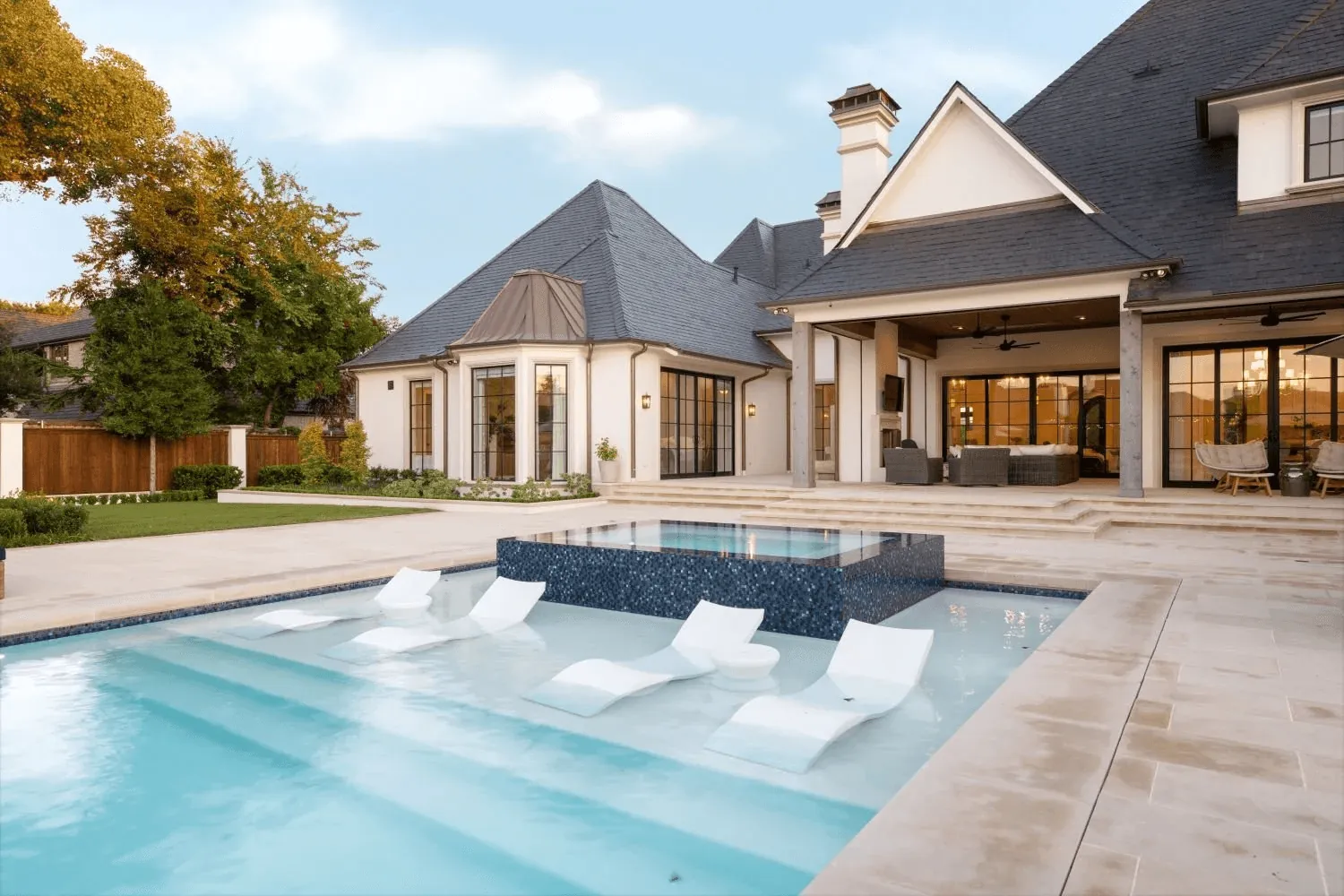
A negative edge is unforgiving because the entire effect depends on one wall — the weir — being and staying perfectly level. Builders set that spillway with laser levels or a transit, because if the edge moves even slightly, the spill becomes uneven and the illusion breaks. In North Texas, the thing most likely to move it is the ground itself. More than 90% of the region sits on highly expansive clay — the montmorillonite-rich soils, including the Houston Black series common across Tarrant and Denton counties, that swell after rain and contract in drought. That cycle puts real stress on any rigid structure built on it, and the weir wall carries the most hydraulic load of all. The decisions that protect a vanishing edge are therefore mostly structural, and they happen before anything visible is built.
An engineered shell and foundation
A properly reinforced gunite shell — the construction method suited to a vanishing edge in this region — designed for the soil conditions on the specific lot, so the weir wall holds its line through the seasons. On most sites this is informed by a geotechnical study and supported by stamped structural plans, which several DFW municipalities require for a pool of this complexity.
Drainage and grade management
Controlling how water moves through the soil around the pool, developed alongside any grading and retaining wall work the site needs. On sloped lots, the negative edge and the site engineering become one problem rather than two, which is part of why the edge wall deserves attention from the outset.
The catch basin and hydraulics
The hidden trough that captures the spill, plus the dedicated pump that returns the water. An undersized catch basin is one of the most common failures in vanishing-edge construction, so the basin is sized to hold the water in motion and the hydraulics tuned so the edge sheets smoothly and quietly rather than surging.
The edge detail and finish
The material and profile of the weir, chosen so the water reads as a clean sheet and the edge coordinates with the surrounding hardscape and coping. This is where the engineering meets the design language of the rest of the property.
Because Blount Designs is a design-and-build firm, the structural plan and the finished look are developed together rather than handed between separate parties. That continuity keeps the engineering in service of the design, and the design honest about what the engineering requires.
How Do You Integrate a Negative Edge Pool Into the Landscape?
A vanishing edge is at its best when it is not treated as a standalone object. The spill side wants a considered foreground beyond it — planting, a lower terrace, a fire feature, or a water element that catches the eye where the pool's edge releases it. Composing the pool alongside the broader water and fire features program keeps the materials and proportions consistent across the whole space, so the pool belongs to the landscape instead of interrupting it. Our guide to custom water features goes deeper on how those moving-water elements are designed to work together.
Lighting, coping material, the deck surface, and the planting palette all get drawn into the same composition. The aim is a pool that looks inevitable in its setting — as though the property always wanted the water exactly there. You can see how that kind of integrated thinking plays out in our modern luxury poolside retreat and geometric oasis projects, where the pool is one part of a fully designed outdoor environment.
What Should You Think Through Before Building One?
The scope of a negative edge project is shaped by the property rather than a fixed package, so the most useful early questions are about the site and the goal. What is the pool spilling toward, and from where will the edge be seen? How much grade does the lot have, and how much structural and drainage engineering does that imply? How will the pool relate to the house, the entertaining areas, and the rest of the landscape? And how do you want to use the space day to day, beyond the visual moment the edge creates? Working through those questions in the design phase produces a plan matched to the property instead of a feature chasing a trend. For a wider view of how a pool fits into a complete outdoor build, our outdoor living work shows the feature in its full context.
Frequently Asked Questions About Negative Edge & Infinity Pools
What is the difference between a negative edge pool and an infinity pool?
They describe the same effect from different angles, and the industry uses the terms interchangeably. An infinity pool is the popular name for the look — water that appears to run off into a view with no visible edge. A negative edge, also called a vanishing edge, is the construction detail that creates it: one wall is built slightly lower so water spills over into a hidden catch basin below, then a pump returns it to the pool. So an infinity pool relies on a negative edge to produce its signature vanishing-water effect.
Do negative edge pools work with Dallas clay soil?
Yes, but the engineering matters more than with a standard pool. Most of North Texas sits on highly expansive clay that swells and shrinks through wet and dry cycles, and a negative edge depends on a level weir wall to spill evenly. That makes the structural design the part of the project that protects the effect: a gunite shell, a foundation engineered for the soil, and drainage that manages ground movement, typically backed by a geotechnical study and stamped structural plans. Done correctly, the edge holds its line.
Are infinity pools harder to maintain than regular pools?
They carry a little more than a standard pool because of the catch basin and the extra pump that returns spilled water to the pool, both of which need to stay balanced and clear. In practice it is a modest addition rather than a burden, and designing the equipment and access thoughtfully from the start keeps upkeep straightforward. For most owners the visual payoff of the vanishing edge is well worth the small amount of added attention.
Where does a negative edge pool make the most sense on a property?
A negative edge does its best work where there is something to spill toward — a downward slope, a view, a green belt, a lake, or a designed landscape beyond the edge. On a flat lot the effect can still be created with grade changes and a raised pool, but the strongest results tend to come from sites with a natural drop or a composed view. Reading the property is the first step in deciding whether, and where, a vanishing edge belongs.
If a vanishing edge is on your mind for your own property, the next step is a conversation about your site, your views, and how the pool fits the rest of your outdoor space. Schedule a design consultation and we will help you plan it as part of a complete landscape. Contact Blount Designs to begin.
Related


