Uncategory
Landscape Architect or Landscape Designer? What Dallas Homeowners Actually Need to Know
-
Blount Designs
We get this question on almost every first consultation. A homeowner has a significant Dallas property — a new custom build in Frisco, a Highland Park estate they're ready to transform, two acres in Aledo that finally need a vision — and they want to know who they're supposed to call. Landscape architect or landscape designer? The titles sound related, the work looks similar in a portfolio, and nobody in the industry seems eager to explain the actual difference. We are.
Blount Designs works directly alongside licensed landscape architects on projects that require them. We know exactly where that line is, and we'll tell you straight.
Schedule a consultation to talk through your project.
What Is the Difference Between a Landscape Architect and a Landscape Designer?
A licensed landscape architect in Texas holds a professional license issued by the Texas Board of Architectural Examiners. That license requires a degree in landscape architecture, a multi-year internship, and passing the Landscape Architecture Registration Examination. In Texas, it is a protected title — you cannot legally call yourself a landscape architect without that license.
The scope of practice that license covers is specific. Licensed landscape architects are qualified to design site grading and drainage systems, manage stormwater infrastructure, produce construction documents for permitted public projects, and take on work where professional liability and stamped drawings are legally required. They operate at the intersection of design and civil engineering, particularly on complex or large-scale projects.
A landscape designer — which is what Blount Designs is — focuses on the full outdoor environment of a residential or commercial property. Design concept and master planning. Spatial layout and flow. Plant selection and material specification for North Texas conditions. Pool and water feature integration. Outdoor kitchens, sport courts, lighting systems, hardscape, and the complete outdoor living experience. This is design work at the highest level. It does not require an architecture license, and the vast majority of luxury residential projects across the DFW metro do not involve the scope that would require one.
There is also an important practical distinction worth naming. Landscape architecture firms are oriented around technical documentation, large-scale planning, and projects with engineering components. A landscape design and build firm like Blount Designs is oriented around what the finished property looks, feels, and functions like — and around executing every element of that vision from concept through installation. These are different disciplines. They are also complementary ones, and on the right project, they work together seamlessly.
When Does Your Dallas Property Actually Require a Licensed Landscape Architect?
The honest answer is: less often than most homeowners assume. For a typical residential project in Highland Park, Preston Hollow, University Park, or anywhere in the DFW metro — even a complete property transformation involving a custom pool, outdoor kitchen, sport court, full hardscape, and landscape redesign — a licensed landscape architect is generally not required.
Where a licensed landscape architect becomes necessary is in specific, well-defined situations.
Large-scale grading that materially affects drainage onto adjacent properties or public right-of-way. If a project involves moving significant amounts of earth in ways that change how water flows off the site, a licensed professional may need to stamp those drawings. This is an engineering question, not a design one. Our grading and retaining wall work routinely involves coordination with licensed engineers when the scope demands it — and we'll tell you upfront when it does.
Commercial projects above a certain size threshold that require stamped engineering drawings for permitting. If you are developing a commercial property, an institutional campus, or a mixed-use project, the permitting requirements are different from residential. A licensed landscape architect may need to be the professional of record on those drawings.
Public-facing projects — parks, streetscapes, institutional campuses — where professional liability must be formally assigned. Any project that touches public infrastructure or is subject to public procurement requirements will typically mandate licensed professional involvement.
HOA or municipality requirements in specific jurisdictions that mandate licensed professional involvement for site plans. Some municipalities and HOAs in the DFW area have their own overlay requirements. When this applies, we flag it before the project moves forward.
If your project involves any of these, we will tell you upfront, and we will refer you to a licensed landscape architect we trust. We have those relationships. We have worked on projects where the architecture team handled the grading and drainage engineering, and we handled everything that makes the property extraordinary to live in. That collaboration is normal and it works well.
What it is not, for most Dallas residential clients, is your situation.
What a Landscape Design and Build Firm Actually Delivers
Blount Designs is a design and build firm. Our focus is on what the property looks like, how it flows, how it functions for the people who live in it, and how it holds up over time in North Texas conditions. We execute. Every project we take on is managed from the initial concept through final installation — no handoffs, no gaps between what was drawn and what gets built.
That means we develop the full master site plan: how spaces are positioned in relation to the architecture, how movement flows through the property, where structures and plantings create privacy, framing, and intentional experience. We specify materials for hardscape that hold up through North Texas summers and winters. We select plant material for DFW's clay soils and extended heat seasons — not generic nursery lists, but specific species and placement decisions that reflect how this region actually grows. We integrate pools, spas, water features, outdoor kitchens, fire features, sport courts, and lighting into a unified environment that functions as a whole.
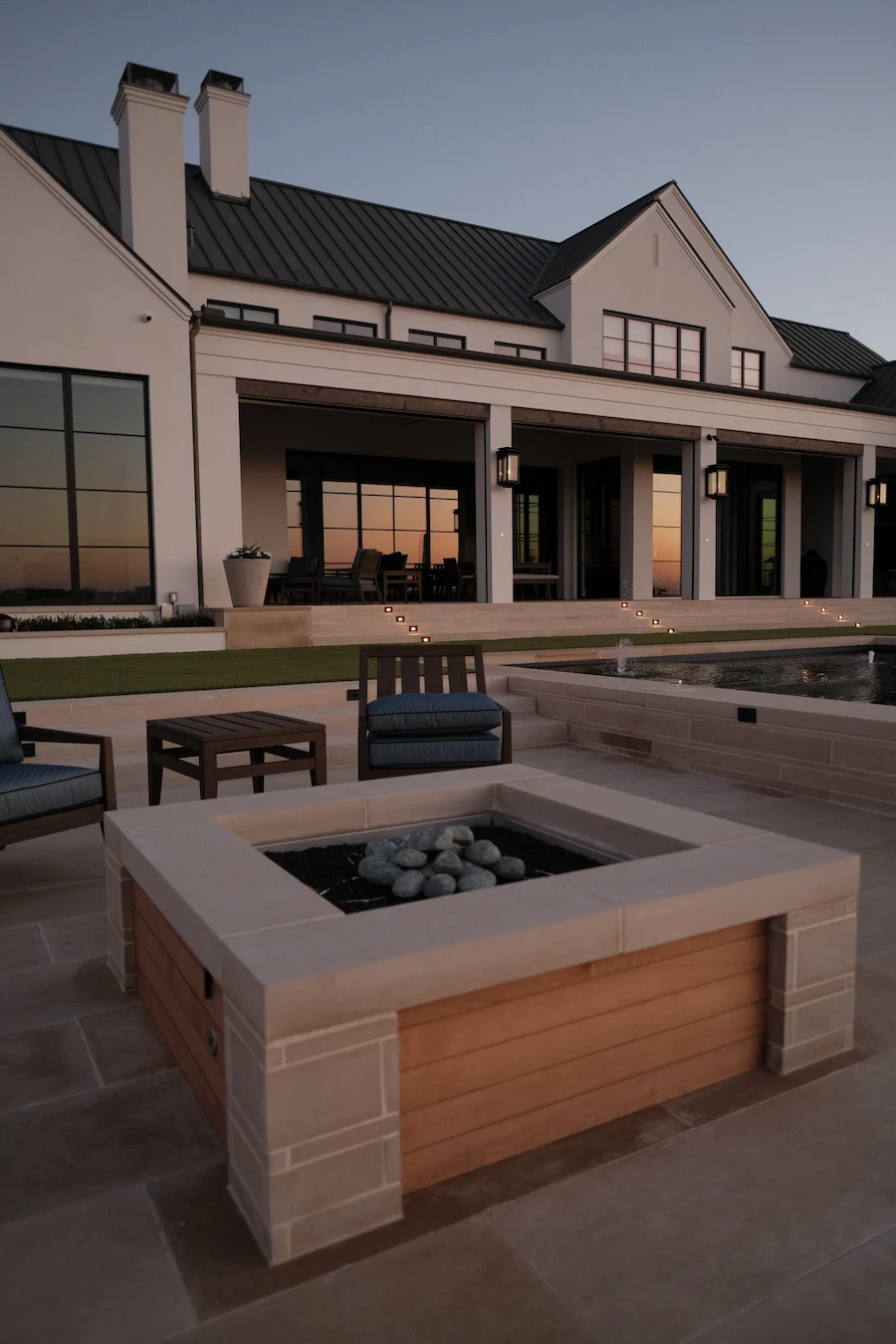
See how this plays out in practice: our Refined Highland Park Retreat is an example of a complete property transformation where the outdoor environment was designed to match the level of the home's interior — custom hardscape, full planting design, water feature, and lighting integrated into a single cohesive vision. The Preserve project in Frisco represents the new construction build scenario — working with a finished home to create a landscape that genuinely belongs to it.
For the homeowner finishing a renovation who wants the outdoor space to finally match the interior — or for the couple who just closed on a new build and refuses to settle for builder sod — the firm you need is one that can take a vision and execute it at the level your property demands. That is what we do.
If you're working through a major property project in Aledo or the western suburbs where acreage is involved, our Aledo landscape design work covers the full-scale land design approach those properties require — not just a yard plan, but a complete land vision.
A Note on North Texas Site Conditions
One dimension of this conversation that rarely gets addressed: the site conditions in DFW create real design and engineering challenges that affect how these decisions get made in practice.
North Texas clay soil is among the most expansive in the country. It shrinks significantly in drought conditions and swells substantially after rain — which is exactly the cycle DFW experiences every year. That movement affects hardscape, retaining walls, drainage patterns, and plant root systems in ways that designers unfamiliar with the region consistently underestimate. Getting this right is not just a design question — it is a material specification, drainage planning, and soil management question that has to be answered at the project level.
Grading on larger DFW properties is often more consequential than it appears on paper. A site that drains slightly toward adjacent properties, or toward a structure's foundation, can create long-term problems that are expensive to correct. This is the area where licensed landscape architect involvement is most likely to become relevant on a residential project — not because of design complexity, but because of drainage and site engineering complexity. We surface this early in every project scoping conversation so there are no surprises.
For everything else — the design, the execution, the outdoor environment that makes a DFW property worth owning — that is the work we have built our firm around. You can learn more about our full approach to what landscape designers actually do and how that scope compares to what most homeowners initially expect.
Frequently Asked Questions
Is "landscape architect" a protected title in Texas?
Yes. In Texas, the title "landscape architect" is legally protected under the Texas Occupations Code Chapter 1052 and regulated by the Texas Board of Architectural Examiners. Only individuals holding a valid Texas landscape architect license may use the title. If you are interviewing firms and someone refers to themselves as a landscape architect without being able to provide a license number, that is worth verifying before you sign anything.
Do I need a landscape architect for a luxury residential project in Highland Park or Preston Hollow?
For the great majority of luxury residential work in these neighborhoods — including complete property transformations, custom pool and spa installations, full hardscape and outdoor kitchen builds, sport courts, and comprehensive landscape redesigns — a licensed landscape architect is not required. These projects fall within the scope of a professional landscape design and build firm. The exception is when a project involves significant site grading, stormwater management, or other engineering components that cross into civil infrastructure. In those cases, we bring in the right licensed professionals and coordinate the process end to end.
How do I choose between a landscape architect and a landscape designer for my Dallas property?
Start with your project scope. If you are building or transforming a private residence — even a large, complex, high-budget one — and the work does not involve public infrastructure or permitted engineering drawings, you most likely need a landscape design and build firm. If your project involves significant land grading, drainage engineering, or a commercial scope, a licensed landscape architect may need to be involved, either leading that specific scope or in a consulting role alongside your design firm. When in doubt, describe your project to both types of firms and ask directly whether a license is required for your specific situation. Any firm worth working with will give you a straight answer.
What does a landscape designer actually do on a project?
A landscape designer develops the full vision and execution plan for an outdoor property. That includes the master site plan — how spaces are laid out in relation to the architecture, how movement flows through the property, where structures and plantings are positioned. It includes material selection for hardscape, plant specification based on North Texas soil and climate conditions, integration of pools and water features, lighting design, and the outdoor living elements that make a property genuinely functional — outdoor kitchens, entertainment areas, sport courts, fire features. On a full-service design and build project, the designer also manages all subcontractors and installation to ensure what gets built matches what was designed. Our North Texas Outdoor Living Investment Guide covers how homeowners across DFW are approaching this scope in 2026.
Can a landscape designer work on the same project as a landscape architect?
Absolutely, and it happens regularly on complex properties. On a large new construction project, the architect of record may handle the building design and structural elements while a landscape designer handles the full outdoor environment. On projects that require engineering-grade site grading or drainage documentation, a licensed landscape architect may produce those specific drawings while a landscape design firm handles the concept, planting, hardscape, and outdoor living scope. The two disciplines complement each other well. What matters is that each firm is working within its area of expertise and that someone is coordinating the full project with clear accountability.
What questions should I ask when interviewing a landscape design firm in Dallas?
Ask whether the firm designs and builds, or designs only. Ask who manages installation and subcontractor coordination. Ask specifically whether your project involves any scope — grading, drainage, commercial permitting — that would require a licensed landscape architect, and how the firm handles that if it does. Ask to see completed projects in your specific area and at a property scale similar to yours. And ask about their experience with North Texas soil and climate conditions specifically — this is not a region where generic regional knowledge is sufficient.
If you have a property in Dallas — whether it is a Highland Park estate that needs a complete transformation, a new build in Frisco that needs a landscape worthy of the house, or acreage in Aledo that needs a full land design vision — the first step is a conversation about what your project actually involves. We will tell you exactly what you need, who should be involved, and whether that is us alone or us working alongside other professionals.
Related